- Today
Hirogawa, Wakayama: Exploring a Coastal Town Shaped by Tsunami History
- Chani Japan
- 1 comment
One of the things I’ve been enjoying lately is having the freedom to get in the car and explore more of Wakayama.
I was searching for a peaceful seaside spot. Just somewhere close enough for a little drive, somewhere I haven’t properly looked around before.
Recently, Millie and I headed south from Wakayama City towards the Arida area and ended up in Hirogawa, a small coastal town in Wakayama Prefecture.
I didn’t go there expecting a big day out. I was really just looking forward to the drive, a change of scenery and a bit of time near the sea.
But Hirogawa turned out to have a much deeper story than I expected.
A Slow Afternoon by the Water
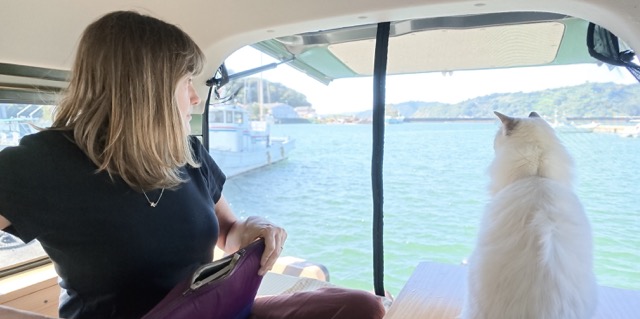
After driving along the Wakayama coast road and through the township of Hirogawa, I made my way down towards the harbour and found a quiet place to park near the fishing boats.
Millie came with me, of course.
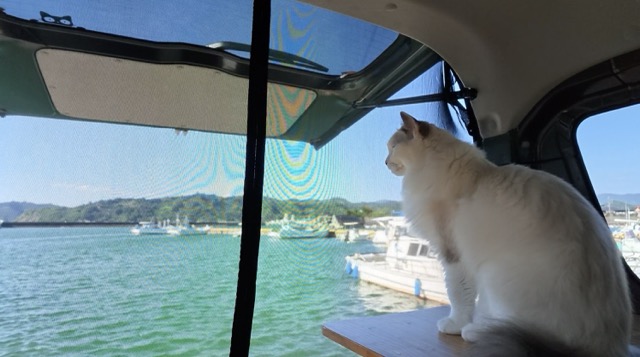
She has become quite used to these little car trips now and seems perfectly happy sitting beside me, looking out the window and watching whatever is happening outside.
There wasn’t much happening that afternoon, which was exactly what I liked about it.
Fishing boats were lined up along the harbour, the streets were quiet, and there were no crowds or sightseeing buses. I parked the car, sat there with Millie for a while and did some writing with the sea just outside and the sounds of the water hitting the fishing boats.
It was simple, but really nice.
Those are often the days I enjoy most now. I don’t feel as though every outing needs to be packed with things to do. Sometimes I just want to drive somewhere, have a look around and stay long enough to get a feel for the place.
Hirogawa is the sort of town where that works.
But as I looked around, I started noticing some unusual features in the landscape.
Large embankments.
Tsunami evacuation signs.
Heavy gates built into the town’s coastal defences.
And that led me to learn more about Hirogawa’s history.
The Tsunami That Changed Hirogawa
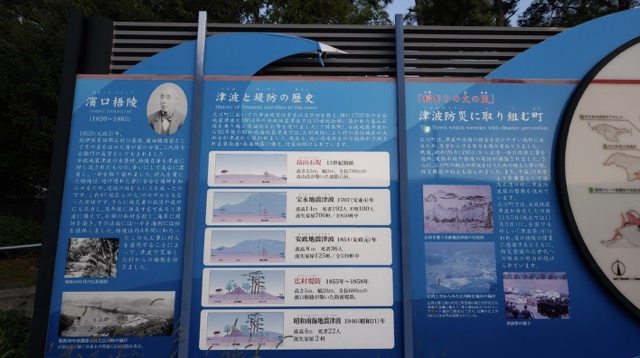
In 1854, the Ansei Nankai earthquake struck off the coast of Japan and caused a major tsunami along the Kii Peninsula.
Hirogawa, then known as the village of Hiro, was badly affected.
One of the most famous stories to come from that disaster involves a local businessman named Hamaguchi Goryo.
When he realised a tsunami was approaching, he set fire to stacks of harvested rice on higher ground. The flames helped guide villagers away from the coast and towards safety.
The story later became known as Inamura no Hi, or The Fire of Rice Sheaves, and Hamaguchi Goryo is still remembered in the town today.
What interested me even more was what he did afterwards.
Rather than simply rebuilding what had been lost, he helped create something that could protect the village from future tsunamis.
Construction began on what is now known as the Hiromura Embankment, a large earth barrier built between the town and the sea.
The embankment stretches for around 600 metres and took several years to complete.
Hamaguchi used his own money to help fund it, while the construction itself also provided work for local people whose livelihoods had been affected by the disaster.
A Seawall That Became Part of the Town
If you saw the Hiromura Embankment without knowing its history, you might not immediately understand what it was.
Parts of it are covered in grass and trees, and today it blends quite naturally into the town.
But it was built for a very practical reason.
It was there to give Hirogawa a better chance the next time the sea came in.
And decades later, it did.
The embankment helped protect the town during the tsunami that followed the 1946 Showa Nankai earthquake.
That is what I found so interesting about Hirogawa.
The disaster-prevention structures aren’t tucked away somewhere as historical exhibits. They are part of the town itself.
People live around them.
Roads pass through them.
Daily life continues beside them.
The town’s history is quite literally built into the landscape.
The Huge Sliding Metal Gate
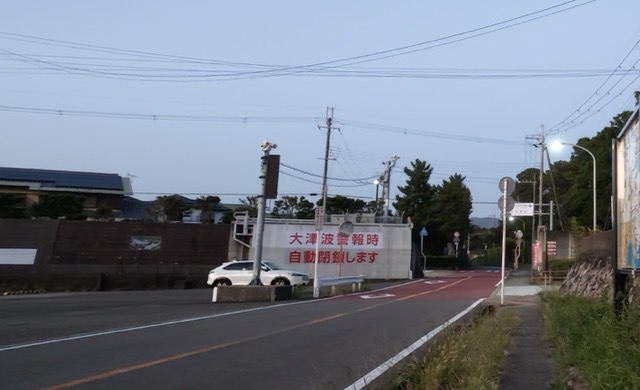
One of the most striking things I saw was a large metal tsunami gate built into the embankment.
It looks almost like an enormous sliding steel wall.
The embankment obviously needs openings so people and vehicles can move through it, but those openings also create weak points if a tsunami comes in.
The solution is a heavy metal gate that can be closed across the gap when necessary.
It is practical rather than decorative, and that is probably what makes it so interesting to see.
You can drive through a quiet Japanese town and suddenly find yourself looking at a piece of infrastructure designed around the possibility of another major tsunami.
It is a reminder that for coastal communities in Japan, disaster preparation is not an abstract idea.
It is part of everyday town planning.
Living With Natural Disasters in Japan
Since moving to Japan, I’ve become much more aware of natural disasters.
In Australia, earthquakes and tsunamis weren’t things I thought about in everyday life.
Here, even when nothing is happening, you notice the preparation.
There are evacuation route signs along coastal roads.
Tsunami height markers appear on buildings and utility poles.
Some towns have evacuation towers or staircases leading to higher ground.
And there are seawalls and floodgates that you might drive past several times before you realise why they are there.
I don’t walk around constantly worrying about earthquakes or tsunamis, but the awareness is different.
You know they are part of life here.
What struck me about Hirogawa was how far back that thinking goes.
The town was already trying to protect itself from future disasters in the 1850s.
Today, visitors can learn more about the 1854 tsunami and Hamaguchi Goryo at the Inamura-no-Hi no Yakata Tsunami Educational Center in Hirogawa.
It gives a much clearer sense of why this small town has become so closely associated with tsunami education and disaster preparedness in Japan.
A Different Kind of Wakayama Day Trip
Hirogawa probably isn’t the sort of place that appears at the top of most Japan travel itineraries.
That’s part of its appeal for me.
There aren’t crowds moving from one famous attraction to another.
Instead, you have a quiet coastal town, fishing boats, old streets and a history that you probably wouldn’t know was there unless you stopped long enough to look.
And that was really what I liked about the day.
I had time to drive around without rushing.
I parked beside the harbour with Millie.
I did a bit of writing.
I watched the fishing boats.
And somewhere in the middle of all of that, I learned about a town that has spent generations living with the sea while also preparing for what it can do.
It gave the place much more meaning than I had expected when I first drove in.
Visiting Hirogawa in Wakayama
If you are travelling through Wakayama Prefecture and enjoy smaller towns, local history and places that sit outside the usual tourist route, Hirogawa is worth a stop.
The Hiromura Embankment, the tsunami gates and the Inamura-no-Hi no Yakata Tsunami Educational Center all tell part of the town’s story.
The wider Arida area is also lovely for a drive, especially if you enjoy the quieter side of Japan — fishing harbours, coastal roads, countryside and towns where life still feels very local.
If you’re looking for things to do in Wakayama, a Wakayama road trip, places to visit near Arida, or somewhere a little less obvious than the main tourist destinations, Hirogawa is an interesting place to spend a few hours.
And I think it is one of those places where it’s better not to rush.
Take a drive.
Have a look around.
Park near the water if you can.
Sometimes that is enough.
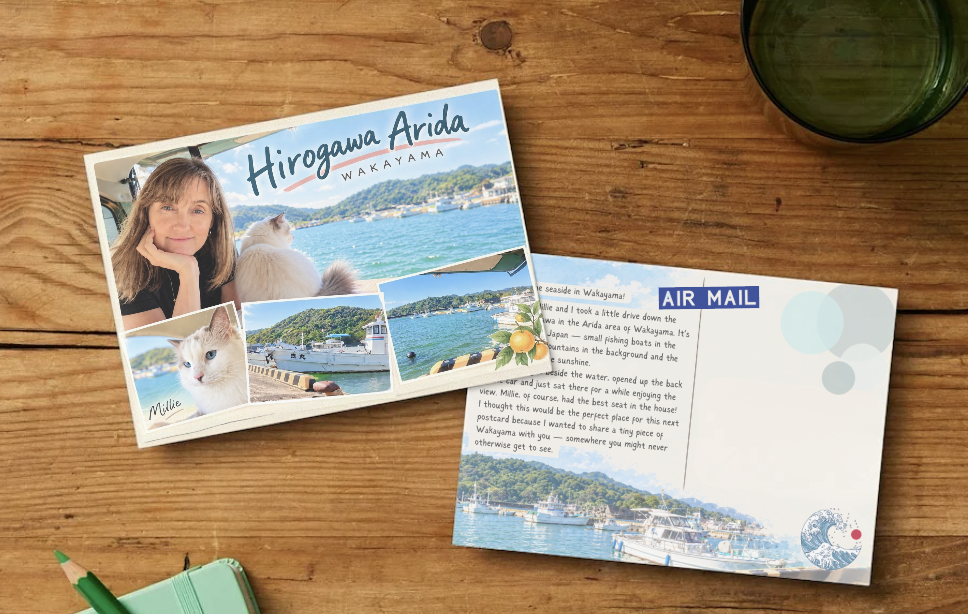
A New Chani Japan Postcard 💌
I also have a new Chani Japan postcard available now.
The Postcard Club has become one of my favourite little parts of what I do because it feels more personal than simply posting another photo online.
There is something nice about sending a real postcard from Japan and knowing that a few weeks later it will turn up in someone’s mailbox on the other side of the world.
Each one is a small snapshot of this life I’m building here — the everyday places, the little discoveries and the parts of Japan that often don’t make it into a travel guide.
If you enjoy following these quieter adventures with me, and you’d like to receive a little piece of Japan in the mail, you can join the LINK: Chani Japan Postcard Club.
And if you’re already a member, keep an eye on your mailbox. The latest one will be on its way soon. 🩷
If you haven't seen the video yet...here it is!
1 comment
In the Netherlands where i live the greater part of the country lies below sea level. We have our dikes, and in places where traffic passes through, we have the same iron barriers as in Hirogawa. We also have the Oosterschelde Barrier—part of the Delta Works—which protects the land during storm surges.Thank you for all the information i appreciate it so much!
If you want to see a beautiful clip of our country and the battle with water here is a link https://youtu.be/1QiftAFZoZM?is=xanWIGdsmLw9Jq4D